About Me

So far, I write about what ever holds my attention the most stubbornly. For the most part we're just doing reviews, but occasionally other things will pop-up as well.

Featured Post

Black Reconstruction by W. E. B. Du Bois

My first post here is of course a Goodreads review, but one of my favorite and the only one that won't show-up on the book's entry p...

Showing posts with label anime review. Show all posts

Friday, July 4, 2025

My Wrap-Up of the 2025 Spring Anime Season

This season was on the short-side for me which is fine given all the anime I plan to watch for the Summer 2025 season). I did binge-watch these shows in the last week of June, so that may play a part in how I view these anime. Of the 7 I have completed (I dropped one that I had actually been curious about: Kowloon Generic Romance), I will give my Top 5 below and do a little sum-up on each:

  1. Aharen-san wa Hakarenai Season 2
  2. KonoSuba: God's Blessing on This Wonderful World! Season 3 OVA
  3. Lazarus
  4. A Ninja and an Assassin Under One Roof
  5. Fire Force Season 3
So "Aharen-san" season 2 was my pick of the season and was a nice way to wrap-up the anime franchise. It brought back the space-brained, but sincere humor of season 1 with all the surrealism and heart that I remembered with the twist of our couple being officially a couple.

I feel like I am cheating by including an OVA, but this is my list in my blog so I make the rules lol. KonoSuba OVA s3 gives you the comedy of the regular season 3, but in two episode specials. One downside was that the animation was noticeably downgraded from season 3, but the writing is what you come to expect from the franchise.

Lazarus was a mixed bag for me. I feel like if it was 24-25 episodes, it would've got its message across better. I think Watanabe was saying something profound about the healthcare industry and human nature, but 13 episodes was not enough time to say it. The aftermath of Luigi Mangione should've made this anime connect a lot more. Still it was not a bad anime: just incomplete by Sinchiro Watanabe's standards. I will still always be anticipating any project he comes out with.

A Ninja and an Assassin Under One Roof is an anime about amoral lesbian contract killers doing slice-of-life/CGDCT stuff. It was a lot funnier than I thought given how it started-off for me and would actually do a little pathos in between the killer-shenanigans. Unexpectedly solid yuri comedy.

Fire Force season 3 is the penultimate anime season of the franchise and one of the last (new) action shounen anime I plan to watch along with My Hero Academica (and I guess Demon Slayer, though I have completed the manga). I have really outgrown that particular genre of anime now given that I started watching DBZ around 1996-97. It was a bit of a chore to get through this season (the first time I have felt that way about FF) and I will be happy when I complete the last season. This and Lazarus were the two anime I watched dubbed in English.


Well that is my look at this season. It may feel like slim pickings, but given the amount of anime I watched in 2024 and the anime I have to look forward to in the second-half of 2025—I am not complaining at all. I may do a write-up of my first impression of Summer 2025 at the end of the month.

Saturday, December 7, 2024

My Review of Kimi ni Todoke - Season 3

[I originally posted this back in August to another site that I was using to track my anime & manga, but it got weird as it turns out the moderators there were out of control with their power so I am reposting this here. Maybe later on I will share my interesting experiment/experience this year of trying to interact with the online anime community after 10 years of not doing that.]


Few anime go as long between seasons as this one. In the time between season 2 and season 3, the landscape of anime romances has changed a lot—partly due to the influences of this series. The manga came to an end and a lot of the tropes utilized in this series would show-up in other series. I think the big impact is the way male-targeted romance series got better over time due to the legacy of this show. Shounen & seinen romances like Insomniacs After School, Call of the Night, and possibly the most interesting example for me—The Dangers in My Heart are just some of the series that owe at least a partial debt to this series. And we haven't even talked about other shoujo romance series. As much as I could talk about the legacy of Kimi ni Todoke, lets get to season 3 itself. 

While the hard work of becoming a couple was resolved in season 2, this season was Shouta and Sawako trying to discover what that means. While they come to terms with that by the end of the season, you could argue that the real focus was the deepening ties and relationship re-evaluation between Chizuru and Ryuu. We already knew about Ryuu's feelings, but now Chizuru was made to starkly and painfully reflect over her relationship with him and it's evolution over the years. This dynamic is the near-highlight of the season. And then we get to Ayane. If Gimai Seikatsu thinks that they have anime's saddest gyaru, Ayane here was trying to give her a run-for-her-money. Her ongoing issues with her self-esteem was given much-needed help by season two's ensemble darkhorse turned (male) hero of this season Kento Miura who was the only person capable of getting through to Ayane (well...almost the only person). As Shouta was in his feelings for most of the season, Kento stepped-up as the only sane male character in the show. Shouta was really out of it in this season as he seemed to not understand how to cope with just being the emotional support for Sawako and nearly destroyed their relationship out the gate before he gets some much-needed wake-up calls from some very unexpected places. This group went on shaky-ground this season, but all came out stronger than before. 

Getting back almost all of the original voice actors was a miracle and it really put me back into the series. The series music was good and always matched the mood of the show. Having the staff from the first two season work with modern equipment really makes a difference and I was always impressed that the composition of the series did not lose the aesthetic of the first two seasons. They could've gone for a more "contemporary" look given they had Netflix money to play with, but one always appreciates keeping the original manga's vision. I also noticed that because each episode was an hour, the story lines could be told in intersecting ways that we normally don't get in your usual thirty minute episode.

All-in-all Kimi ni Todoke uses it's simple, to the point, but sincere storytelling to remind everyone why it is still the gold-standard of shoujo romance in the 21st century. Where other series have done too little or too much, it gets the recipe perfect. I hope they adapt the whole manga and the sequel, but until then I am happy with this.

Monday, September 30, 2024

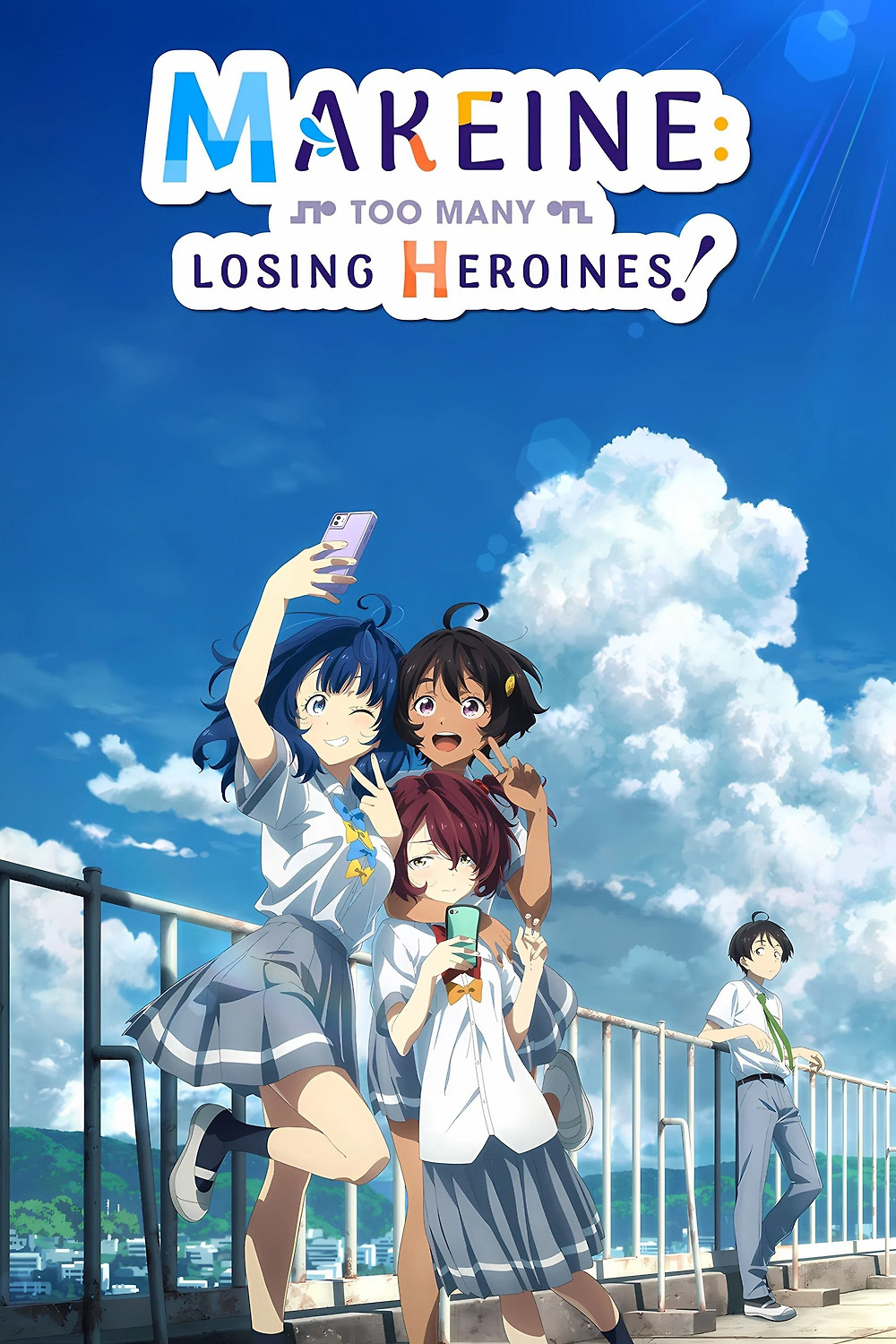
My Review of Makeine: Too Many Losing Heroines!

 Joy & Pain: like sunshine and rain


I can't say what exactly one could label this anime when you get right down to it. Romance? Yeah ok. Comedy? Most defintely. Harem? Yes and no. When I added this series to my schedule at the last minute, I thought of it as nothing more than another harem adaptation and something that could fill-out my Saturday anime-watching schedule until I got bored of it. I had no expectations of it as it was a last-minute add. Like everyone reading this review, I had my doors blown off by the end of the first episode and knew that I had stumbled upon something special. The show promised that it was going to be subversion/commentary on the light novel romance formula, but ascended to become something unique in its own right. It focused on makeine—the Japanese word for the unlucky girl in the love triangle—and it showed a look of love, compassion, and dignity for these characters rarely shown in light novels or anime. The comedy and heart in this series is so balanced that one could find yourself shaking with laughter and holding back tears in the course of one episode (hell, the first episode itself is a prime example). I think it is ironic writing this review almost a week after the death of Frankie Beverly, but I could not help but have the words to his song Joy & Pain in my mind throughout this anime's run. 

Remember when you first found love how you felt so good.

Kind that last forever more so you thought it would.

Suddenly the things you see got you hurt so bad, so bad. 

How come the things that makes us happy makes us sad?

Kazuhiko Nukumizu Is a lonely highschooler whose only friend in the world is his sister and who really enjoys light novel romances, despite never being in love himself. While eating alone at a cafe, he witnesses one of the most popular girls in his class, Anna Yanami, get rejected by her childhood friend who decides instead to date one of her other friends (who may be even more popular). Nukumizu watches the painfully-embarrassing aftermath of this and his and Anna's eyes meet awkwardly after she is caught drinking out of her beloved's cup after he has rejected her and left for the victorious heroine. Thus began one of the most intriguing relationships in recent-anime history. While Anna, Lemon Yakishio (track star who gets rejected by a guy who goes to Nukumizu's cram school), and Chika Komari (who gets rejected by her Literature club president/senpai), form his harem/girl posse(?). I suppose the anime concludes by simply letting us know they are his friends—though it becomes clear that Anna has plans to play the long-game into getting a relationship upgrade when the time is right.

Love can be bitter, love can be sweet.

Sometimes devotion, and sometimes deceit.

The ones that you care for, give you so much pain

Oh, but it's alright, they're both one in the same.

I think one of the big things that stops this harem anime from being a conventional hare anime is that only one of the female protagonists has any interest with being the male protagonist's boyfriend—and she's deliberately taking her time in a very savvy way. A "harem" anime where the male protagonist is not in any love triangle/polygon with the female protagonists. All the other girls are in love triangles of their own and Nukumizu's primary function is to act as support for them aka be a friend. Only Anna shows any romantic interest in him, but is not going to jump the gun until he is able to return those feelings. With all the love wars mostly happening on the other-side of our not-harem, we are more looking at how Nukumizu acts as a friend with people who are not his sister and how he slowly learns more about himself through this process. Each girl is given an arc where their losing romance is allowed to play-out and those arcs (specifically Lemon & Komari's) are explorations of how these girls who were deeply in-love reconcile with being in the friend-zone and they each show their own unique takes. We get a little of this with Anna, but not a lot as I can guess her story is the most deeply intertwine with Nukumizu himself, so we'll have to wait for the sequel to learn more about her. In any case, the arcs of Lemon and Komari were masterly-done and really show the debt this series owes to its spiritual predecessors My Teen Romantic Comedy SNAFUKaguya-sama: Love is War

Listen, don't it seem we go through life going up and down?

Seems the things that turn you on turn you around.

Always hurting each other

(If it ain't one thing it's another)

When the world is down on you, love's somewhere around.

The other thing we need to mention here is the production. Good lord I knew A-1 Pictures was good, but this was Steph Curry in the Olympics good from them. They went all-in on making this little known light novel series the masterpiece that it was visually. No expense was spared on detailing every scene and individual action to its finest detail. Rarely have I ever seen a comedy this well-animated before. I feel bad for the production committee for Gimai Seikatsu which was adapting a very somber light novel romance this year of it's own and while going for an art house-feel, did not achieve the same artistic peak that this anime did. The voice actors here are mostly on the newer-side and they each rose to the occasion. It's not too surprising that the anime studio behind franchises like Kaguya-Sama: Love is War, Idol Master, and Lycoris Recoil could make a good anime, but this was on a different-level even for them. It seems A-1 Pictures took the hard lessons they learned from their disastrous production of 86 and turned their operation completely around. Still amazed that there was no pause this season, despite the high quality of animation. I guess it also helps when one of the financiers on your production committee is the Central Japan Railway Company (JR Toukai Agency). That might be a first. 

Over and over you can be sure

There will be sorrow but you will endure (You will endure)

Where there's a flower, there's the sun and the rain

Oh, but it's wonderful, they're both one in the same.

I don't think that anyone working on this anime knew it was in for the critical reception it got. It seems the light novel author Takibi Amamori was caught off-guard with him stepping-in to write an original anime-only episode for the finale rather than anything from the light novels. I suspect he will be busy for the foreseeable future. I feel like after this series, the whole industry has been put on-notice that these new creators aren't going by the old rules anymore. The fans only stand to benefit.

Tuesday, March 26, 2024

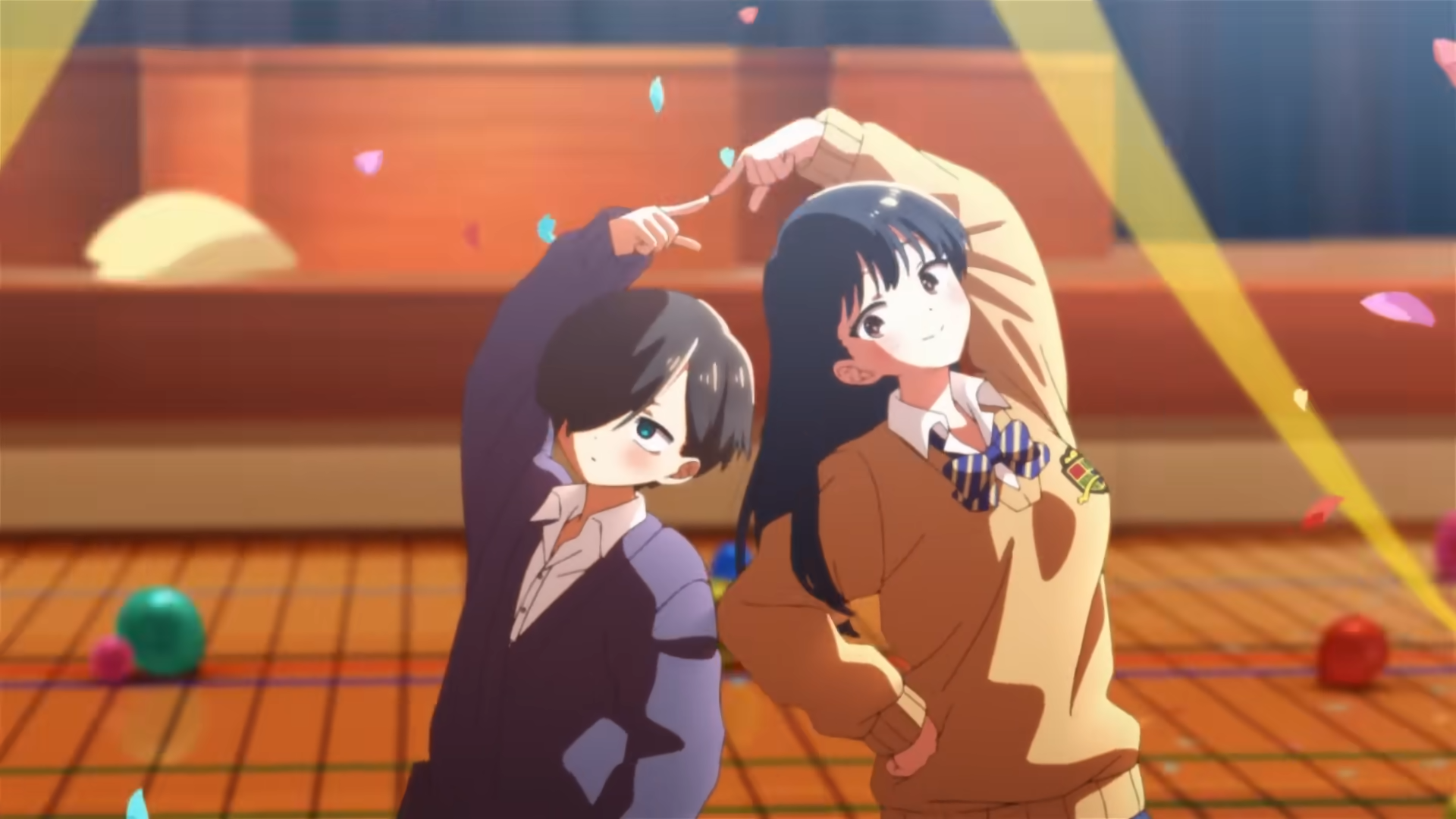
My Thoughts on Season 2 of The Dangers In My Heart - The Best Shonen Romance I Have Ever Watched


It has taken me a long time to find a TV shonen anime that I thought was better than Please Teacher (I was much younger when I watched it, don't judge me). To be sure, the shonen genre has not historically had romance as the top-priority, but through the years the idea of showing romantic relationships from the point-of-view of teenage and young adult males, for teenage/young-adult males has been a rising phenomenon since the 1980s and rise of works by people like Rumiko Takahashi. This trend continued into the 21st century and we see much romance work in the shonen demographic. The problem is a lot of them are not that good or convincing. While we get an excellent romantic comedy like Kaguya-sama: Love Is War, More realistic or straight-forward romance have been more of a mixed-bag or rather a stale-bag. 

One of the most annoying things for most western audiences is the stock Japanese romantic archetypes: the extremely shy, extremely chivalrous male and the either equally shy or extremely "forward" female protagonist. These stock tropes are often taken to their extreme in manga and anime. In recent years creatives in the industry have endeavored to break-out of these clichés (most notably in LGBT fiction) and recent works have started to subvert things. The success in winter 2024 of A Sign of Affection shows that western audiences are craving for a more familiar, honest relationship between the main couple in these shows.

While I'm not a big expert or connoisseur of romance fiction, I have been fascinated at how anime and manga handles these the subject. Growing up with the format, I did not care about this when I was young, but as I age and wanted more emotionally-mature work, the limitations of shonen anime/manga becomes more apparent (this is less the case in shojo, but the rule still applies). I am more at home with seinen anime obviously given my age, but I think that seinen is marginally better at relationship and josei is probably as good as it will get when it comes to romance in anime and especially manga (which makes it very unfortunate that josei manga are the least likely works to be adapted into anime). When I watched My Love Story with Yamada-kun at Lv999 in Spring 2023 it had a similar effect in the shojo demographic (for me) that the subject of this review has had.

The first season of The Dangers in My Heart was an interesting affair. The synopsis and 1/3 of the first episode is a fake-out and it reveals from the second half of the episode, the beginning of the love story of Kyotaro Ichikawa and Anna Yamada. The world of these two are very different on the surface, but their awkwardness and emotional vulnerability brings them together. They are learning to love themselves while falling in love more with each other. The first season is showing how alienated and afraid of himself Kyotaro is and how Anna, his classmates, and finally he starts bringing himself out of this alienation. 

This season sees him go step by step to become the person he truly wants to be and that his sister alludes that he use to be. The realism of his insecurities and that of the people around him is as realistic as I have seen in awhile. He doesn't magically improve himself overnight, but almost each episode showed some improve meant in him that felt earned. The people around him are not nearly as terrible as he thought they were when he met them and the idea that he could not love someone like Anna is easily disproven without feeling so unrealistic. Though the story is from Kyotaro's pov, it could have easily have been from Anna's pov and not lose any of its power. Because we are not in her head the way we are in Kyotaro's we have to infer her emotions and inner-thoughts from her visual cues. The way she goes out her way to match him and emotionally and his trying to do the same despite how different personalities were is a key point to where we know they are going to become a couple. Even the male gaze is not played for fetish, but feels visceral and awkward as we see it from Kyotaro's point-of-view.

An interesting aspect of this show is the meta-dialogue it has with Kimi ni Todoke. In TDIMH, there is a parody version of KnT that Kyotaro & Anna are both fans of. The in-universe version of KnT's Shōta Kazehaya becomes the conscience "inner voice" for Kyotaro and gives him very honest advice on what he knows he wants or what he knows he needs to do. It is up to Kyotaro on whether to listen to him or not. The irony is that Kyo is obviously more similar meta-wise to KnT's Sawako Kuronuma. Both Kyo and Sawako have become withdrawn and had their self-esteem crushed by events prior to the stories’ beginning. The key to both stories is that they encounter friends and romantic partners who help change them for the better. Now a key difference is that the former title is a shonen romance and the latter is a shojo romance so the temperament of both stories will be different. Also, the drama that Sawako faces is almost-completely external, while it was just one external incident that motivates the internal trauma of Kyotaro. For the more old-school knowing anime fans, Kare Kano is worth a look to compare to this anime.

The production quality has certainly been boosted and the music and editing is really incredible. The way that they introduce the episode title at the end of every episode is masterful at tying the theme of the overall story together. The voice acting is to be commended on how they really go hard for the nuances of Japanese teenagers to an almost painful degree.

When I look at this franchise, I feel like it offers a hope. It tells a favorite type of love story for me: the main character has to remember to love themselves as much as they love their beloved. One is hopeful that more shows that subvert the old standards of anime romance are adapted and/or created. I can't wait until the next season of this anime is made. This show is process, redemption, love.

Friday, September 24, 2021

EVA is Done, FINALLY!! My Review of Evangelion: 3.0+1.0 Thrice Upon a Time (2021) directed by Hideaki Anno

 Thanatos - If I Can't Be Yours ("10 Years After Remix") by Loren & Mash


Finally!! After 14 years of these "Rebuild" films and 26 years of the franchise overall, Neon Genesis Evangelion has ended. This franchise has spanned nearly 2.5 generations of anime fans. I first heard of it when part of the original tv series was featured on Toonami's "Robot Week" back when I was still in grade school. Now I am way older I have seen everything and had to wait over a decade for this crazy, beautiful-looking, overloaded with pop-philosophy, glorious mess wrap-up. I'll let everybody else talk about the "message" behind this movie and the franchise as a whole (you have 25 years worth of that to read/watch), but I'll just try to give my very short takes on the movie and the franchise.

Everything You Ever Dreamed (Alternate Version) by Arriane

The movie is basically trying to one-up and undo the art and message of End of Evangelion (one of the most controversial films in anime history) respectively. The question that folks had going into the "Rebuild" films was is Hideaki Anno going to let Shinji & Co. have a happy ending compared to how the franchise originally ended in 1998 or was he going to screw them all again? Thankfully, he chose the former: let them have as happy an ending as possible and send them on their way. The story is very much what you expect from Eva, but the ending allows everyone to get on with their life. The true wonder of this movie is the visuals. This being the last Evnagelion property means that they went all out and it looks amazing, no other way to put it. The music likewise is pretty much what you expect and want from Shirō Sagisu at this point and his original music and the pop songs used in this film (both English and Japanese) are what you want from this franchise. On a different note: did you know that Sagisu made a British R&B/Hip-Hop album remixing his music from Eva to coincide with the release of EoE in 1998? It is official out-of-print, but you can find the whole album on the Internet Archive: https://archive.org/details/evangelionvoxflac 

Promised Land (F-2) by Loren & Mash

While Shinji Ikari will always be one of my least favorite protagonists in fiction as a whole, this franchise pretty much re-wrote the rules of anime and is one of the most well-know properties this sides of the format. So much anime that we have now simply would not exist if a man did not think: "what would really happen if we put traumatized teens into giant 'robots' to fight supernatural aliens?" Well, 26 years later and I guess we have the answer...and it ain't just more fanservice.

One Last Kiss by Hikaru Utada

Tuesday, February 2, 2021

Princess Mononoke (1997) directed by Hayao Miyazaki

 "I am not attempting to solve the entire world's problems. There can never be a happy ending between humanity and ferocious gods. Yet, even amidst hatred and carnage, life is still worth living. It is possible for wonderful encounters and beautiful things to exist. I will depict animosity, but that is in order to show the fact that there is something more precious. I will depict the bondage of a curse in order to show the joy of liberation. What I will show is the boy reaching an understanding of the girl, and the process of the girl's heart opening up to the boy. In the end the girl may say to the boy, 'I love you, Ashitaka. But I can't forgive human beings.' The boy will smile and say, 'that's alright. Won't you live together with me?' 

This is the kind of film I want to make." – Hayao Miyazaki's April 19, 1995 pitch for Princess Mononoke


How The Sun First Rose on "Japan"

This film is neck-and neck with Castle in the Sky (1986) for my favorite Hayao Miyazaki film. This film was the first of many of Miyazaki's "final films." This film has one of the fiercest female protagonist of his his movies up to that point and along with Miyazaki's environmentalist themes, had a strong look at Shinto spirituality and an amazing allegory of the founding of that country that we call Japan.

An Emishi boy, a civilization of Yamato settlers and iron workers led by a female warlord who is an amazing call-back to the female antagonist of Nausicaä of the Valley of the Wind (1984), and the various forest kami–especially wolf kami–that have taken a human girl dressed in Jōmon-era clothes as their own interlock with each other over the land and each other's existence during the early Muromachi period. From these three mutually-hostile groups will be the creation of we now call "Japan." San aka the titular Princess Mononoke represents not simply the natural world but, pre-historic Japan at it's roots—symbolized by her Jōmon clothes; the antagonist Lady Eboli represents represents the contradictions of modern civilization and the brutality of the Yamoto conquest of the islands that they would call Nippon: she's kind to all the outcast of that era of society, but she takes all her rage on the land and the kami that live in it. In the middle is the co-protagonist Ashitaka who represents the Emishi not so ancient as the Jōmon, but one of the ethnic groups that resisted easy assimilation or subjugation to the Yamoto hegemony: they were until the end (or beginning depending on how you look at it) of the Muromachi period offering an alternative to what we now think of as "Japanese culture" on the main island of Japan—much closer to the land than the Yamoto, but still a human civilization. This movie reminds me of Maya Angelou's On The Pulse of the Morning, but in a Japanese context. Nobody has a reason to trust one another—and all the reasons to destroy each other. But it is shown in  the little moments that when they do work and relate to each other with compassion, they can make great things happen. Tragically greed, prejudice, and a simple lack of understanding means that history will eventually play out…as tragedy.

It is amazing how beautiful the artwork is here—95% hand-drawn (this was the first Studio Ghibli film to use CGI). Miyazaki closed out the 20th century (and what he thought was his career) with this film: Princess Mononoke is a true masterpiece of not simply anime, but animation cinema as a whole. There wouldn't be another film of this caliber for me until Your Name (2016) almost 20 years later.

Friday, October 23, 2020

Castle in the Sky (1986) directed by Hayao Miyazaki

 The film is the technical first film of Studio Ghibli film by the legendary Hayao Miyazaki. It is not taking the man vs nature theme in quite the way Miyazaki usually does. We have a more complex debate on technology and ambition. The movie is almost like two films harmonized in perfect sync. A combination of fantasy and sci-fi (of the steampunk variety) and one where the character are all the more complex than we are initially led to believe. The strong female character are featured here as is usual for a Miyazaki movie.

The movie ask if people really deserve paradise. The protagonists and antagonists are searching for a secret floating city called Laputa and when they find it are presented with a hard choice. The ideas and aesthetics of the movie brought steampunk into the mainstream of anime and directly influenced Nadia: The Secret of Blue Water by Miyazki's acolyte Hideaki Anno. It is a sharpening of the design of the animation from Nausicaä of the Valley of the Wind (1984) (though the plots are similarly strong). I am very torn between Castle in the Sky and Princess Mononoke (1997) for my favorite Miyazaki film.

Wednesday, August 12, 2020

My Review of Miss Hokusai "百日紅" (2015) directed by Keiichi Hara (with references to Toni Morrison)

Alfred Hitchcock once said that cinema was life with the boring parts cut out. He obviously didn't count on the fact that some of us our very much entertained by the "boring parts." This movie is a slice-of-life look at the 19th century ukiyo-e artist Ōi Katsushika the daughter of the legendary Hokusai Katsushika. This women was an artist of great talent who has been obscured by history. This Movie is an adaptation of a manga by Hinako Sugiura--a manga artist also mostly-forgotten by history. Sugiura's manga and this film are poetic looks, not at the facts of Ōi's life, but the truth of it via what Toni Morrison called "the site of memory."

In her essay The Site of Memory, writer Toni Morrison explains how she tells the truth of her characters' daily lives. When looking at the interior life of a person, facts fall short because they don't have real emotional energy: 

 "When I hear someone say, 'Truth is stranger than fiction,' I think that old chestnut is truer than we know, because it doesn't say that truth is truer than fiction; just that it's stranger, meaning that it's odd. It may be excessive, it may be more interesting, but the important thing is that it's random--and fiction is not random. 

Therefore the crucial distinction for me is not the difference between fact and fiction, but the distinction be-tween fact and truth. Because facts can exist without human intelligence, but truth cannot.

"The image comes first and tells me what the 'memory' is about." - From The Site of  Memory

 I encountered this idea straight-on when I watched Miss Hokusai (2015) for the first time and learning the scant facts in English about Sugiura has made this movie all the more mysterious yet personal, truthful.

We don't know much about the facts of Ōi. A lot of what we know about her come from the fact of her proximity to her father--given that she was his chief assistant. We don't know when she was born or when she died as women in the Edo Period were not considered important-enough to record that sort of information. In the movie, her and her father are often hanging-out with the artists Eisen Keisai & Kuninao Utagawa who were pupils of Hokusai. What the film's creators got from the original manga was not going to help because the late-Hinako Sugiura was just as obscure and eccentric as her subject. None of Sugiura's work, that I know of, has been translated into English so I have no way of knowing what the movie did differently from the manga myself. All of this meant that for the Sugiura, and later, the film-maker and screenwriter Miho Maruo was, that they had to abandon the hopeless search for facts and go for the truth in the process as Morrison said, "The image comes first and tells me what the 'memory' is about."

The movie opens with Ōi walking through town narrating about her father's exploits and encountering Kuninao Utagawa on a bridge; we are shown that it is summer 1814. She visits her mother who does not live with her and her father (or actually it may be the other way around), and her little sister who is blind and ill and lives in a Buddhist hospital of-sorts. Hokusai's fear of mortality keeps him from visiting this child. Hokusai himself is presented as almost fully-driven by his art, but also dependent on Ōi for organizing his work properly. She is in artist in her own right and we see artwork by her, her father, and their two friends shown or visually referenced throughout this film. 

There is no actual plot or narrative to this film. It is a series of vignettes of incidents that we drop-in on involving the artists--Ōi in-particular. Two of these episodes I want to touch on briefly. At one point Ōi, Hokusai, and Eisen Keisai go to the red-light district to sketch an oiran (Japanese courtesan during the Edo Period). They hear that she is semi-possed and that when she sleeps her neck "stretches" and tries to leave her body. The artists mange to convince the oiran into letting them observe this event and it is a visual stunner that really plays into almost magical realist territory. A lot of the vignettes are like that, we see artistic fantasy and reality blend together and we accept it for what it is. The other moment is the death of Ōi's sister O-nao. Hokusai had spent the film avoiding her, but is eventually convinced to see her and goes. She dies not long afterwards and it is a surprisingly emotional scene coming into the climax of the film.

The animation work of Production I. G is flawless and the voice acting was refreshingly naturalistic--especially Anne Watanabe as Ōi. This film should have been more celebrated, but it came out right before the juggernaut Your Name (2016). As the film ends and we leave the site of memory, we learn about what happened to the main cast after the events of the movie including "Miss Hokusai's" disappearance from the historical record. We get one more look at the walking bridge that the movie opened-on before it we cut directly to the same area in 2015 in which the foot bridge is now traveled by cars. It is a powerful-point that drives home that while maybe everything that happened in the film was fact, all of it was true.